Document lifted edges, missing material, branch impacts, and wind-driven rain paths before choosing temporary protection, repair, or replacement.
After a Massachusetts wind event, the important damage may be a bare patch of decking, but it may also be a creased tab, loose rake metal, shifted flashing, or a membrane edge that opens only under pressure. Coastal exposure adds wind-driven rain and salt-air wear at fasteners and edge metal. Inland tree cover adds punctures and scuffs that should be traced beyond the obvious strike point. Call (617) 397-4837 for a free storm inspection. Stay on the ground, record safe exterior and interior views, and leave close roof photos to the contractor. The resulting scope should separate urgent weather protection from permanent work.
Inspect the path of force, not only the missing material
Wind works first at exposed edges, ridges, corners, and any tab or flashing lip it can lift. A branch can puncture one spot while loosening fasteners or scuffing shingles downslope. The inspection should cover each roof plane, ridge and hip material, rakes, eaves, penetrations, edge metal, gutters, and roof-to-wall transitions. Interior staining and attic marks should be photographed where access is safe. Each image needs context: which slope it shows, what condition is visible, and whether the finding is storm-related or ordinary age cannot yet be determined. That record supports a repair decision without turning every cosmetic mark into a replacement claim.
Coastal exposure concentrates wear at the perimeter
On the South Shore and Cape Cod, open exposure and salt air make perimeter details part of every storm check. Wind can work under shingles at rakes, push rain behind fascia or chimney flashing, and stress a low-slope termination. Salt-air wear may already be visible at fasteners, drip edge, vent metal, or flashing before a storm finds the weak point. The contractor should distinguish recent openings from longer-term corrosion or aging because the permanent scope may need both a localized repair and correction of the vulnerable edge. Cedar and complex coastal work is custom-quote only; material condition and access must be inspected in person.
Keep insurance documentation tied to observed conditions
A contractor can photograph what is visible, prepare an itemized repair or replacement scope, and meet an adjuster when that is useful. The record should not promise causation that cannot be established or a coverage result the contractor does not control. Coverage decisions belong to the insurer. Avoid any proposal built around a “free roof,” a waived deductible, or guaranteed approval. Compare the documented roof condition, your policy process, and the written construction scope as separate decisions. The roof inspection page explains what belongs in a condition review, and the cost guide provides planning ranges that are independent of insurance outcomes.
Stabilize an opening before debating the final scope
An open roof, torn membrane, or active interior leak may need a tarp, board-up, or temporary membrane patch before permanent materials can be installed. That first visit is about reducing additional water entry without creating unsafe work in active wind, lightning, or ice. It does not settle whether the final answer is a small repair, section replacement, or full replacement. Review emergency roof repair for safe steps while help is being arranged and roof repair for the permanent diagnostic process. After the roof is stable, ask for a second written scope that identifies removal, decking, flashing, material matching, cleanup, and municipal permit responsibility.
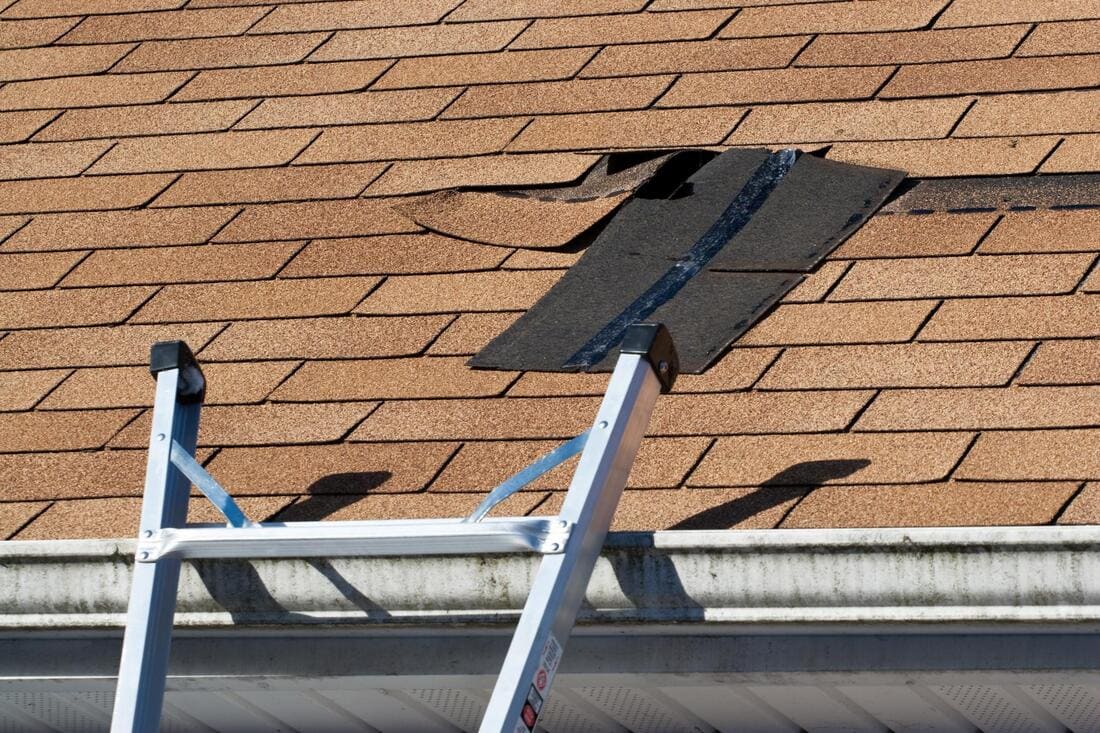
A creased shingle or loosened edge can admit water even when the roof looks mostly intact from below.
From a safe position, photograph material in the yard, visible roof openings, bent gutters, damaged siding edges, ceiling stains, and accessible attic moisture. Note when the condition appeared. Do not climb a wet, icy, steep, or wind-damaged roof, and do not stand beneath loose branches or hanging exterior material.
Can coastal wind damage be hard to see?
Yes. A shingle can lift and settle back with a crease, edge metal can loosen at a fastener, and wind-driven rain can cross a flashing joint without leaving a wide opening. Steep, tall, and low-slope roofs all have details that cannot be judged reliably from the street.
Does storm damage always mean replacement?
No. A limited group of shingles, one flashing detail, or one membrane opening may be repairable when the surrounding roof is sound. Replacement becomes more reasonable when damage crosses several planes, compatible repairs cannot be tied into brittle material, decking is compromised, or unrelated leaks were already recurring.
Speak with a Massachusetts roofing contractor serving your area. Under M.G.L. c.272 § 99,
recording begins only after the required all-party notice is provided.